
Another Kind of Terminal Uniqueness
We're obsessed with being the wrong kind of 'special.'

My oldest daughter was born in Scottsdale. I brought her home from the hospital to a bright, airy desert spring in a house just off 12th Street and Greenway. It’s the only time of year in Phoenix where you can really keep your windows open 24 hours a day, without dust or pop-up monsoons risking your curtains (and lungs). My earliest memories with her are sitting on the couch in my sunny living room, with the windows open, singing “Down to the River to Pray” over her little sweet face.
We moved back here to Ohio (where I grew up) when she was five months old, so she doesn’t remember being a Phoenician. That doesn’t stop her from claiming the title, though. As it shouldn’t. It’s become a point of pride for her; she’s very exotic to her classmates. She’s from Arizona. She’s a “desert girl,” she says. This tickles me, in part because I’m just happy that some decision I made a long time ago — before I even knew her — is a source of joy for her. But also because I hated living in Phoenix for such a long time, and because I think if we brought our daughters back there - really brought them back, to sweat through the impossible summers, to never quite be cool enough, to suffer the melting of their rubber flip-flops and the inaccessibility of everything fun outside (including the pools!) from July to September — they’d almost definitely hate it.
“Uniqueness” carries a currency that I’m not sure makes sense. It makes intuitive sense, but not logical sense. My daughter is proud of being from Arizona because no one else in her class is from Arizona. None of the Ohio kids in her class are broadcasting their origins, anyway. As if “born in Akron!” were a cool party trick.
I get this, and I do it, too. I love telling people here that we lived in Arizona for seven years. Midwesterners don’t travel as much as people in the southwest do, and are much less likely to move far away from their hometown. That’s probably because Midwest families have been here much longer than any non-indigenous person has been there. I love when people ask me how and why we ended up there, and I get to tell them ‘we wanted to go somewhere totally new! We just pointed at a map!’ Because I think it makes me seem daring and whimsical, and I like to think of myself in those terms.
I wouldn’t feel daring if everyone closed their eyes, pointed to the 50 states on a map and then moved where their finger landed (an exaggeration of our case, sure, but it’s how I like to tell it). But why not? Does moving across the country with no job and no local contacts to a new city and new climate require less bravery if lots of people are doing it? I don’t see how it could.
We idolize the relative rarity of our particular decisions. I’ve been ruminating on this lately in relation to the larger cultural conversation we’re having about motherhood. I saw it again, the other night, in a throwaway scene in the sitcom St. Denis Medical (think The Office, but in a hospital). A young hot nurse has a mini-crisis when she realizes she’s been at this same job in this same hospital for five years. She could’ve been traveling the world and having “wild experiences” like her traveling-nurse friend, she says. Is she just going to ‘settle’ here in this town, get married to some guy, and pop out a few “rando kids” (direct quote) and… what? That’s her life now? Please God, no!
To be fair, by the end of the episode, miss HotPants RN comes to the realization that she has “lots of friends here,” something that Traveling HotPants RN doesn’t have, and that’s not nothing. I guess that’s sweet. But this is still weird, right? Is getting married and having kids really the flattened, airless, dead-end version of a woman’s life? Or is the dead-end life the version in which she chases “experience,” wild and free, until she’s too old and has to stop? Which one seems more likely to disappoint?
I think it’s possible that the reason marriage and motherhood have a reputation as the consolation prize is because they are commonplace. Not common, as in banal, but commonplace. Marriage and motherhood are profound, but anyone can (hypothetically) do it. It is not exotic. It does not raise eyebrows at a party, it does not signal one is daring or whimsical, and most people therefore won’t envy the person who does it — because most people are doing it, too.
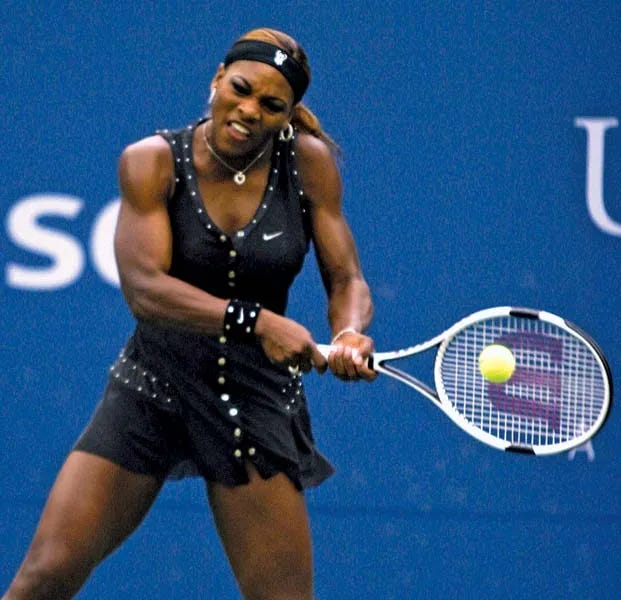
Exhibit A: A few years ago, Serena Williams wrote an essay in Vogue announcing she was retiring from tennis in order to focus on having a second baby. She didn’t want to play tennis with one foot on and one foot off the court, she said, and I respect the hell out of that. She chose her family. A good choice, in my estimation, and one I hope she’s happy with. But in that essay, she also wrote:
Believe me, I never wanted to have to choose between tennis and a family. I don’t think it’s fair. If I were a guy, I wouldn’t be writing this because I’d be out there playing and winning while my wife was doing the physical labor of expanding our family. Maybe I’d be more of a Tom Brady if I had that opportunity.
I remember reading this at the time and tripping over the word “fair.” It’s not fair? Who, exactly, wronged Serena, here? Biology?
To me, this was a weird inversion. Personally, and I don’t share this often, but… I’ve never been a world-class tennis player. I’m actually terrible at tennis. But I’ve had plenty of dreams, and some professional success. But not even my wildest delusions of grandeur (Editor at The Free Press, recurring guest on Dax Shepard’s podcast, paid to spend a month solo in County Galway each year to write a new book for which the world waits, breathless) could compare with my real-life experience of having my babies. And by “having” I mean the entire gambit: being pregnant with them, giving birth to them, breastfeeding them, taking care of them, watching them grow, getting to know them as people, getting to know myself as a mom. My kids love me, want me, and need me more than they love, want, or need anyone else in the world. There will never be a day in my life when they don’t. If we’re talking ‘fair’ and ‘unfair,’ here, everyone who doesn’t get to experience this is getting the short end of the stick. I’m including my own husband in this equation! And our girls love him a whole lot!
From this perspective (ie. the right one) Tom Brady is the one to be pitied. I get that he doesn’t have to take time off to gestate if he wants to have kids (does Tom Brady have kids? Did they inherit his chin?) But the tradeoff is… he never gets to gestate! Also, consider how measurably less salient Serena Williams’ point seems now, just a few years later. Tom Brady is retired from football. Everyone’s body sets the limit eventually.
People have been talking a lot about “meaning” lately — that the mental health crisis (and, frankly, the birth rate crisis) plaguing the West is a casualty of a culture-wide loss of a sense of moral purpose. It’s logical to define the meaning of one’s life by what they bring to the table that no one else could. I just read a book about Socrates, and he was famous for defining ethics by asking questions; by finding virtue by whittling away what it wasn’t. It makes sense to me that part of our search for personal identity involves defining what we’re not; or what we have that no one else does. That’s why fame and power are so alluring — the world had never seen someone play tennis the way Serena Williams, and she knew that. It undoubtedly made her feel important.
But we’re making a critical error if we conflate uniqueness with meaning, and I’m afraid that’s what we’re doing. No, not everyone can play tennis like Serena Williams; and yes, lots and lots of women, so many women, can be mothers. But no one but Serena Williams can be a mother to Serena William’s children. And if you ask her children whether they care that the woman who puts her hand to brush the hair off their cheeks each morning, and who kisses their warm foreheads at night and who listens endlessly to their stories, who feeds, consoles, nurtures and teaches them, who prays for them, who dies a million little deaths for them every single day is their actual mom or whether any ol’ warm body will do, well. No. There’s no one but mom; tennis star or no.
In other words, transcending our self-destructive obsession with uniqueness probably requires, paradoxically, a deeper fidelity to true uniqueness. If I live a quiet life, needed and known by not many more than one or two or 10 other people, I believe I will still feel and know the meaning of myself. Because no one else can be me for those one or two or 10 people. I think at the end of our lives and beyond we will each measure our time here by those particular people, and not the other 7 billion. We should probably think about that now.
As a redhead, I am obviously super unique (j/k). But I completely agree. I tire of hearing how *less* motherhood is. Wanna be truly unique? Live a life of quiet, sacrificial love to your spouse and family, with no accolades, social media platforms, or online “influencing.”
I want to also add how much it breaks my heart that the simple act of my husband taking his son to the park to work on baseball skills (yep, playing catch—how mundane, right?!) caught the attention of an elderly gentleman who tearfully praised him. “You never see this anymore.” To be clear—he meant loving dads making concerted efforts to spend one-on-one time with their kids. These things used to be *expected*; now they’re apparently too oppressively stereotypical.
The world is upside down *and* backwards.
I sought 'uniqueness' - tattoos, weird fashions, boutique tastes, bizarre philosophies, etc. - and meaning - career, hobbies, etc. - my whole life. The only things that have made me feel worth a damn was 1) being a husband and 2) being a father. I get a lot of enjoyment out of some of my hobbies, but they don't give me meaning. They're just a pleasant way to spend some free time.
I remember feeling like something was missing after my wife and I got married. We didn't think we wanted kids. I remember thinking, so this is it? We just work and grab dinner and a drink or take weekend trips until we're dead? I wonder how many men and women, who think they don't want kids, have that same sense of something missing and go try to find it in an affair or a career change or a divorce or whatever. If you have a loving marriage, that's the foundation for a family.
As a man, I think our urge is more about leaving a legacy. Your kids will tell their kids and their grandkids about you. They keep you alive well after you're dead. And if you're a good man, you can set, reinforce, or re-set a certain legacy of what it means to be a good man and set an example across generations. That's something beautiful, meaningful, and fulfilling. I think of my beloved "Pops" (maternal grandpa) and how much we still love him and talk about him as a family - and he's been dead for coming up on 25 years. That's something that's better than my degrees or work accomplishments. I want to be a good man, husband, and father because I know it will shape my kids and their lives. And because, more than anything else, I love them. Those words are empty if I don't try to be my best for them.